Cultural heritage in the Muros town of water and salt tour.
Santa maría do campo
Parish church, formerly Collegiate
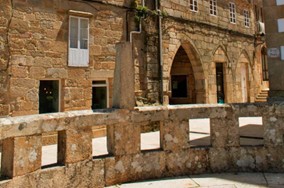
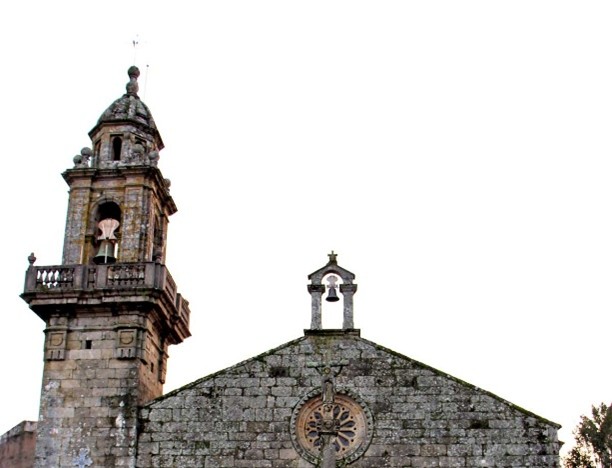
At the top of the town, in the 12th century, the church of Santa Maria del Campo was erected. In 1500, when Pope Alexander VI granted the parish of Muros the right to a Collegiate church, it was temporarily awarded to the church of San Pedro; but before long renovations to the church of Santa Maria began, in order to properly reflect the town’s new status.
Today all that remains of the original Romanesque elements are the main entrance, some corbels and stone engravings. The nave and apse were rebuilt in Gothic style to suit the mariners’ taste, the large pointed arches being notable elements. By 1500 the Rosary Chapel and the sacristy had already been added.
The conversion to Collegiate expanded the site. Throughout the 16th and 17th centuries the side chapels were opened out. In the 18th century some of these were enlarged, and communicating arches were created by way of lateral naves. It was also around then that the baptistry and bell tower were erected.
Hidden away among the decorations are two telling engravings: stars formed by fish.
Where
Rúa Rosalía de Castro
Also…
The Collegiate Church is the starting point of the Muros, Town of Water and Salt guided tour of Muros
Iglesia de S. Pedro – Centro de Visitantes
Old parish church
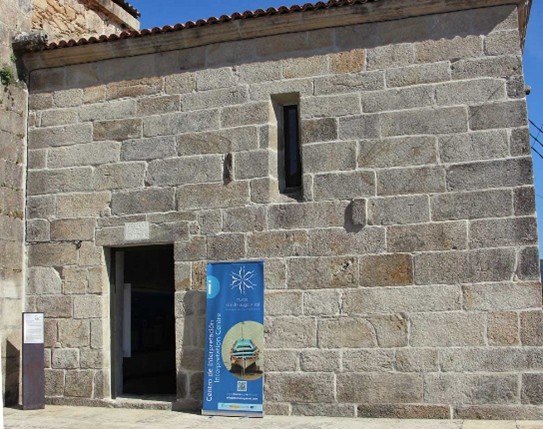
This site, now deconsecrated, is Muros’s oldest recorded parish church. The chapel, which the visitor center now occupies, is what remains of the old church of San Pedro de Muros.Some reports suggest that the parish of San Pedro de Muros existed in the 10th century.
In 1500, Pope Alexander VI granted it the status of Collegiate church, which would later pass to the church of Santa Maria del Campo (Saint Mary in the Field).
To note:
– Inscriptions on the outside wall. They usually refer to individuals who participated in the construction of the chapel.
– Corbels, under the cornice. Very typical of the Romanesque style, they include three human heads and various geometric motifs.
– Ornaments on the facades, with a very worn lamb (Agnus Dei) on the western side and a cross on the eastern.
– Inscriptions inside, corresponding to tombstones.
– Baptismal font in the former vestry. Inside you can still read the inscription ‘JESUS-FILIUS PATER CUR SPRITU SANTO. SIGLO XV’.
– Vaulting in both spaces, the former chapel and the sacristy. They are ribbed vaults, supported by decorated capitals.
– Remains of the old nave, now a cemetery. Part of one of the walls can still be seen, with small chapel- tombs.
Where
Rúa do Hospital
Also…
It is the Interpretation Centre of Muros, Town of Water and Salt
A Virxe do Camiño’s sanctuary
Gothic Christ and votive offerings
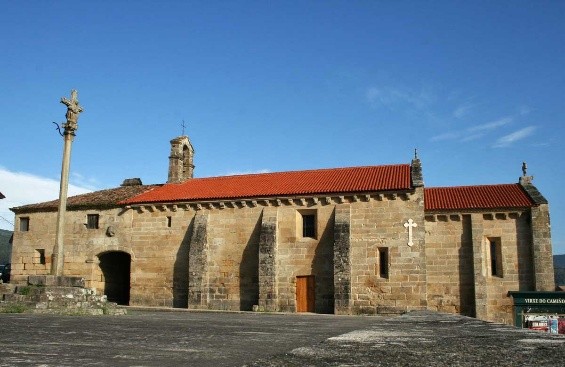
This church is emblematic of maritime society and its religiosity.
For one thing, it appears to have been linked from the beginning to a lepers’ hospital and thus to charity. For another, it was central to maritime devotion: fishermen and sailors put their trust in Our Lady of the Way, evinced by a constant stream of votive offerings – offerings of gratitude for divine favour.
Records exist, and remains can be seen, of an ancient Romanesque chapel. However, the existing sanctuary dates from the fifteenth century. It is marine Gothic in style. The nave, in four sections, is formed by three pointed arches that support a wooden roof and rest on buttresses. The main altar at the back of the church has ribbed vaulting.
The 14th-century Christ Crucified deserves special mention.
It is a Gothic carving in the Tuscan style, unparalleled in the Peninsula (except for a similar image that was in the Collegiate church of Santa Maria del Campo in La Coruna, now located at La Rabida in Huelva). The original cross is gone and the figure suffered modifications during the Baroque period, such as the hair being cut off to be replaced by a wig, and repainting. During the Gothic period, the image of Christ was humanized: the representation of his suffering, his most human aspect, is emphasized. The somewhat restrained expression of pain through the symbols of the passion, the face and the body, are characteristic of the Tuscan school. Perhaps it is not, after all, surprising to find it in a town that had maritime contacts with Italy. This same church received, as a gift from Genoa, the marble baptismal font.
Also characteristic of the sanctuary are its votive offerings, thanking the Virgin for interceding in times of danger, whether from a storm or a pirate attack, as shown in two pictures from the 18th century which narrate the events through text and illustration. Particularly striking is the model ship known as the Transit Frigate, donated probably in the 19th century for unknown reasons.
Where
A Virxe do Camiño’s place
Also…
In mid-August, don’t miss the Virxe do Camino celebrations
Chapel and O Carme neighborhood
Mariners’ devotion
This chapel is a private endowment, built in 1767 at the expense of Jeronimo Duran, from Muros but resident in Chile, at that time a part of the Viceroyalty of the River Plate. It represents the end of the Galician Baroque period, by then coexisting with neoclassicism. On the facade, framed by a pair of pilasters, the portico and coat of arms stand out. Inside, note the sculptural altar setting, presided over by the Virgin of the Carmen (Mt Carmelo in Israel).
Nearby has stood since medieval times the Old Tower or Tower of the Archbishopric, which symbolized the dominion of the Compostela mitre over the town of Muros
Where
Rúa do Carme (Carmen Lane) and nearby streets
Also…
Merits a special visit during the Carmen celebrations, around the 16th of July.
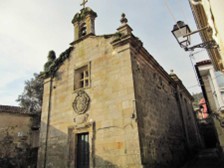
Os Remedios chapel
The ‘cruceiros’ (stone crosses) marking out the countryside
Where
Rua Axesta (Axesta Lane), coming into Muros from Noia.
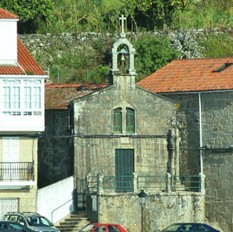
Chapel and neighboardhood of S. Xosé
Spirituality and solidarity
The area around the chapel of San Xose, with its many steps, exemplifies the adaptation of the town centre’s features to the terrain. The small chapel, privately owned, dates from the beginning of the 18th century, as does the cross that stands before it.
Nearby is the Hospital of the Trinity, or Poor Hospital, which from medieval times up to the early 20th century tended the most needy – Muros inhabitants as well as travellers and pilgrims. It retains that spirit today, as a social centre.
Where
Rua San Xose (St Joseph’s Lane) and surrounding area
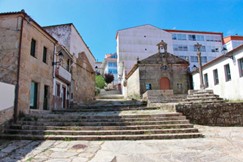
Rúa de Axesta
The town’s growth
There is mention of the street and neighborhood of Axesta from the 18th century, when the authorities encouraged house-building in the area. It was thus one of the growth areas of the city in modern times. Here was located the Justice Scroll, the column that symbolized Muros’s jurisdiction, extending to nearby municipalities. Convicts were tied to it for public ridicule.
The Rua de Axesta and its continuation the Rua Real (Royal Lane) form an axis, parallel to the waterfront, running through the higher part of old Muros. With stone buildings either side, it transports us to olden times.
Where
Rúa de Axesta (Axesta Lane)
Also…
Continue your tour along the Rua Real (Royal Lane)
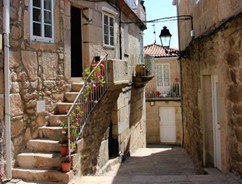
Praza de abastos
Evolution of the fish pedlars
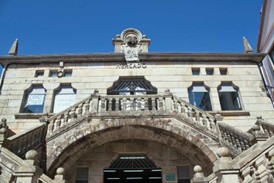
The Muros Market welcomes us with its double flight of steps. They have stone balustrades with mouldings, and balls on top.
Inside, fresh produce from land and sea is sold. It is the antithesis of the past, when the women of Muros travelled the streets, and the paths inland, to sell fish fresh off the boats
Where
Praza do Mercado (Market Square)
Also…
Open every workday.
A Vella (The Old Woman)
Women of the sea
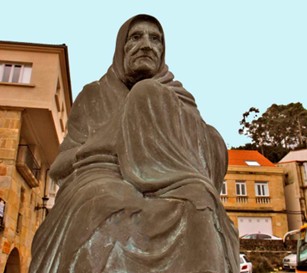
At one end of the esplanade, A Vella has been sitting and watching the sea for some years. This sculpture by Ramon Conde is a tribute to those who have been lost at sea and also those, women especially, who awaited their return.
Where
Esplanade.
This is a Heading Example
Tide mill
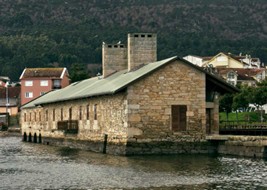
In such a maritime village, even agriculture made use of the sea. In this case, it used it for grinding grain. With increased cultivation of corn, the small river mills could not cope with the demand, so in the early 19th century the Muíño de Bazarra, (Bazarra’s Mill) was built, named after its builder. Today it is better known as Muíño de Pozo do Cachón (Waterfall Pool Mill). Owing to its size and state of preservation, it is one of the most important tidal mills in the Iberian Peninsula.
The mill is driven by tidal rise and fall. Key to its operation is the dam, over 230m long. It fills with water at high tide and the dam is closed to prevent it flowing out. When the tide has gone out the sluices are opened, channelling the water to drive the millstones and grind the grain.
Here, above these ‘moas’ (molars or millstones) stands a long building which was used for storage, and even as a bathhouse, for treatment with seawater and seaweeds. Today it is a cultural center, open to the public.
Salting factories and canneries
The industrialization of the Estuary of Muros and Noia
From the Middle Ages the port of Muros was known for its fish production, especially the sardine, which could be widely exported thanks to salting. From the late 18th century, the wealth of the seas attracted many industrialists, who settled in Muros and around the bay. They brought a new approach to traditional practices. First the salting factories, then the canneries completely changed the economy of Muros and the lifestyles of the people of the sea. The great explosion of this new industry took place during the nineteenth century and lasted well into the next century. However, overexploitation had its drawbacks, and eventually led to the closure of many of the factories. Here are some whose ruins still delineate the coastal landscape.
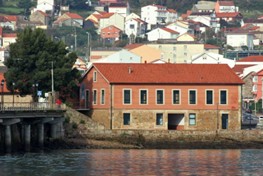
Sel Cannery: the Sel family, from Castro Urdiales, came to Muros in the late nineteenth century on their return from emigration to Argentina. They created a cannery which processed mainly sardines, but it survived until the 1970s thanks to shellfish. The building that housed the factory is visible, refurbished, by the road to Serres and Noia.
In the opposite direction, going towards Carnota, the ruins of Joaquin Vieta’s factory still stand, with a jetty. From the Sanctuary of the Virgin of the Way can be seen, across the inlet, the Three Gables, the remains of the Romani factory. And, one after another, throughout the town center and all along the coast, there are vestiges of that industrial past, some now just memories.
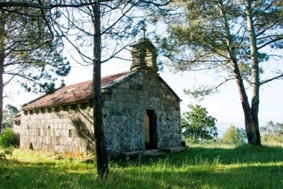
The small chapels
Popular devotion
Religious practice in Muros led to other small temples being built throughout the parish. They help us to understand the nuances of maritime devotion.
Capilla de las Nieves (Chapel of the Snows).
Built in the 18th century, beside the so-called Holy Spring on the hillside of As Neves, the chapel is unique because of its surroundings and its outstanding views. It is in fact a hermitage, to which a porch giving access has recently been added. The villagers traditionally go to the spring since it is believed to have miraculous powers.
Chapel of San Roque.
There is record of its existence from 1609, but its present appearance is baroque, in the style of the second half of the 18th century. It is composed of three distinct spaces: nave, sanctuary and sacristy. It hosted a brotherhood, whose chaplain was a canon of the Collegiate.
Capilla del Espiritu Santo (Chapel of the Holy Spirit).
An old Gothic hermitage. The interior of the building is divided by arches which support a pointed barrel vault. The original small and primitive construction was enlarged in the 1920s using material from the ruined chapel of St Cross.
Documents from the 18th century allude to the presence of a hermit who ‘sheltered’ in an adjoining house and subsisted on a vegetable garden. Both house and garden belonged to the hermitage.
Capilla de San Marcos (St Mark’s chapel).
Situated in the woods and recently refurbished, an annual pilgrimage picnic is once again celebrated here. According to an inscription over the doorway it dates from 1480, although the form is Romanesque, a barrel vault being the main structural element. On the exterior are corbels, representing scrolls, triangles or animals. Two decorative elements are of particular interest: representations of flattened faces in the shape of the moon.
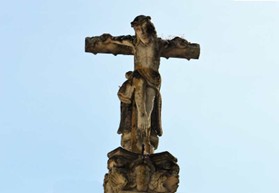
‘Cruceiros’ (carved stone crosses)
Marking the territory
The role of the ‘cruceiros’ was to sanctify everyday spaces, in town centres, on paths, or in more remote locations. They have been common since the Gothic period and usually represent the Christ crucified on the front, the side facing towards the main path, and the Virgin Mary or a saint on the back.
‘Cruceiros’ and other crosses in the parish of Muros:
– Cruceiro del Cementerio (Cemetery cross).
– Cruceiro de Santa Rosa (St Rose).
– Cruz de O Rumial.
– Cruceiro de la Virgen del Camino (the Virgin of the Way).
– Cruceiro de la Capilla de Santa Cruz (Chapel of St Cross).
– Cruceiro de la Capilla de la Nieves (Chapel of the Snows).
– Cruceiro de la Plaza del Cristo (Christ Square).
– Cruceiro de Santa Isabel.
The old town centre of Muros
The seafaring soul
The old town hugs the harbour. It is one of the best-preserved fishing villages on the Galician coast. From the harbour we see the long facade of galleries and arcades: the beach used to go right up to them. The Curro da Praza (Pound Square), overlooked by the Town Hall, is the meeting place, and a good starting point for getting to the higher areas. The traveller will have already spotted that, from the waterfront, narrow alleyways lead inside the town.
The long lane called Axesta and then Real runs parallel to the waterfront, little squares, fountains and ‘cruceiros’ (stone crosses) emerging with every step; also churches and chapels, with the former Collegiate Church of St Mary in the Field overseeing the town.
Of the old castle which defended Muros from the Middle Ages to the French invasion, only some remains of the town wall can still be seen; more characteristic are the mariners’ dwellings, looking out to sea, and the modernist buildings, testifying to Muros’s growth through fishing-related industries.
The old town centre of Muros has been a listed Historic Site since 1970.